
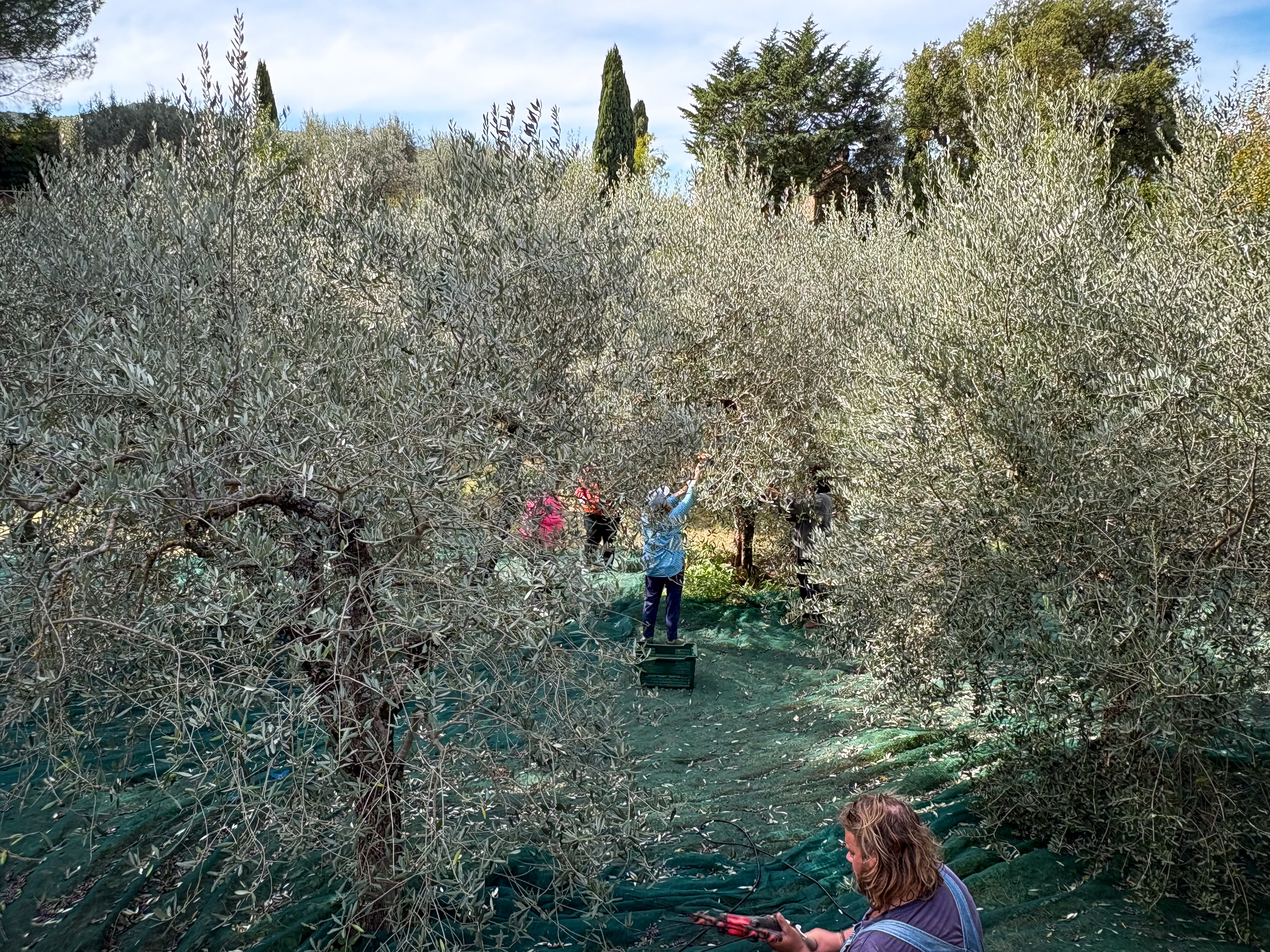
Just got back from Umbria, and what a week it was.
This was my first olive harvest, a chance to finally see, touch, and live the process end-to-end. From tree to bottle, I got to experience every step of what becomes Solo Olives.
The Journey
I landed in Rome and was picked up by my friend Stijn (whom many of you know as Maestro dell’Olio). We headed straight north to his home in Panicale, a beautiful medieval town perched above Lake Trasimeno. The next morning, we were in the grove, ready to start the harvest.
The plan was ambitious: to finish a grove of about 250 trees in two days.
Our target was 150 liters of oil, which in a good year would come from roughly 150 trees. But nature had its say this season, it’s been a year of pests, particularly the olive fruit fly (mosca dell’olivo). Stijn fought them successfully using only organic treatments, like hanging bottles filled with fermenting bait to attract and trap the insects. You may have seen some of this on our videos earlier this year.
Two Days, 900 Kilos, 100 Liters
Over two long days, we collected around 900 kilos of olives from roughly 250 trees in the grove, mostly Moraiolo, Leccino, and Frantoio varieties, the classic Umbrian mix.
The yield came out to around 9–10%, which means about 90–100 liters of oil in total.
To put that into perspective: each half-liter bottle of Solo Olives represents about 4.5–5 kilograms of olives, roughly 10 pounds per bottle when the yield is high. That’s hundreds of olives in every bottle, each hand-picked (or shaken) from the trees.
We used abbacchiatori, long, lightweight electric sticks with vibrating fingers at the tip that shake the branches, gently combing through the canopy to knock the olives down into the nets. They make a loud buzzing sound and require rhythm and care; you need to find the right angle and tempo to shake the olives loose without damaging the branches. Once a section was done, we’d lift and shift the nets themselves to guide the olives into piles before gathering them up.
Every olive matters, because each one means a few more drops of oil. Leaving any behind is like leaving gold on the ground. After shaking, we’d rake through the nets and even pick up the smallest ones by hand to make sure none were wasted.
It was intense physical work, long days under the sun, neck craned upward for hours, arms buzzing from the tools. By the end of the second day, I could feel it everywhere: my neck, my back, even a bump on my wrist from holding the abbacchiatore all day. Between the time change, the long drives to the mill, and over 16 hours of harvesting, I was running on coffee, adrenaline, and pure excitement. Exhausting? Completely. Worth it? Absolutely.
We started early with espresso and a small pastry, then worked until lunch. Lunches were simple and perfect, pizza, local beer, or a glass of Umbrian wine. Afternoons were tougher: the sun stronger, the air thicker, and the mosquitoes relentless. But even through the tiredness, the work had a kind of meditative rhythm, the sound of the tools, the smell of the trees, the sight of the nets filling with fruit.
From Grove to Mill
Each evening we loaded the crates into the van and drove 45 minutes to Perugia, where our partner mill operates. This is the same facility that bottles our oil and meets all the FDA requirements for U.S. export. It’s a fascinating process that I’ll detail in another post soon.
The olives were milled the same night they were picked, to preserve freshness and quality. The oil was then stored under nitrogen, filtered once, and will be filtered again before bottling to remove any remaining particles. That keeps it vibrant green but crystal clear, and helps preserve flavor and shelf life.


A Taste of Life in Umbria
Beyond the work, there was so much beauty.
The golden afternoons. The rhythm of the countryside. The friendships. The food. The small moments between picking nets and olive branches that reminded me why we started this journey in the first place.
The oil itself is stunning, bright green, alive, spicy, and full of character.
As a chemical engineer, I can’t wait to see the polyphenol profile, but even without the data, the taste tells the story: this is a powerful, healthy, fresh olive oil, true Olio Nuovo.
And honestly, every time I drizzle some of it now, I can feel it, that same neck ache from looking up at the trees, the tired arms from shaking branches, and the hum of those long Umbrian days. Each bottle holds not just oil, but those memories too.

What’s Next
Once the final batch is pressed and tested, we’ll bottle and ship the oil to the U.S.
If all goes well with tariffs and customs, we’ll have it ready for Thanksgiving.
The entire batch will be limited, when it’s gone, it’s gone.
Thank you all for supporting this project, for following the journey, and for believing in what we’re building. I’ll be sharing videos and clips from the harvest soon, so you can see the people, the process, and the passion behind every drop.
Ricardo
Solo Olives · Umbria, October 2025
Availability ETA end of November.


Leave a Reply